Sampling methods#
Estimation of failure probability due to wave run-up (Hunt’s equation)#
In this example, we will demonstrate the application of the sampling-based reliability methods (crude_monte_carlo, directional_sampling, importance_sampling, adaptive_importance_sampling, subset_simulation and latin_hypercube) to estimate the probability of failure of a levee due to wave run-up. The failure mechanism is characterized by the Hunt’s equation, which is a simple model to estimate the wave run-up.
Define model#
First, we import the necessary classes:
[27]:
from probabilistic_library import ReliabilityProject, DistributionType, ReliabilityMethod, SampleMethod
We consider the following limit state function:
\(Z = h_{crest} - (h + R_u)\)
where:
\(h_{crest}\) is the crest height of the flood defence (m) \(h\) is the water level on the flood defence (m) \(R_u\) represents the wave run-up (m)
The wave run-up \(R_u\) is derived using the Hunt’s equation:
\(R_u = \xi \cdot H_s\)
with:
$:nbsphinx-math:xi `= :nbsphinx-math:frac{tan (alpha)}{sqrt{2cdot pi cdot H_s/L_0}}` $
\(L_0 = g \cdot T_p^2\)
where:
\(H_s\) is the significant wave height (m) \(T_p\) is the peak wave period (s) \(g\) is the gravitational acceleration (\(9.81 m/s ^2\)) \(\tan (\alpha)\) is the slope of the flood defence (-)
The parameters \(h\), \(H_s\) and \(T_p\) represent the imposed load, while \(h_{crest}\) and \(\tan (\alpha)\) stand for the strength of the levee.
[28]:
from utils.models import hunt
To perform a reliability analysis, we create a reliability project and specify the limit state function (model):
[29]:
project = ReliabilityProject()
project.model = hunt

project.model.print()
Model hunt:
Input parameters:
  t_p
  tan_alpha
  h_s
  h_crest
  h
Output parameters:
  Z
We assume the following distributions for the parameters present in the limit state function:
[30]:
project.variables["t_p"].distribution = DistributionType.log_normal
project.variables["t_p"].mean = 3
project.variables["t_p"].deviation = 1

project.variables["tan_alpha"].distribution = DistributionType.deterministic
project.variables["tan_alpha"].mean = 0.333333

project.variables["h_s"].distribution = DistributionType.log_normal
project.variables["h_s"].mean = 3
project.variables["h_s"].deviation = 1

project.variables["h_crest"].distribution = DistributionType.log_normal
project.variables["h_crest"].mean = 10
project.variables["h_crest"].deviation = 0.05

project.variables["h"].distribution = DistributionType.exponential
project.variables["h"].shift = 0.5
project.variables["h"].scale = 1
Perform reliability calculations with Crude Monte Carlo#
We start with the reliability method crude_monte_carlo. The reliability analysis is executed using project.run(), and the results are accessed from project.design_point.
[ ]:
project.settings.reliability_method = ReliabilityMethod.crude_monte_carlo
project.settings.minimum_samples = 10000
project.settings.maximum_samples = 50000
project.settings.variation_coefficient = 0.025
project.settings.save_realizations = True
project.settings.save_convergence = True

project.run()

project.design_point.print()
project.design_point.plot_alphas()
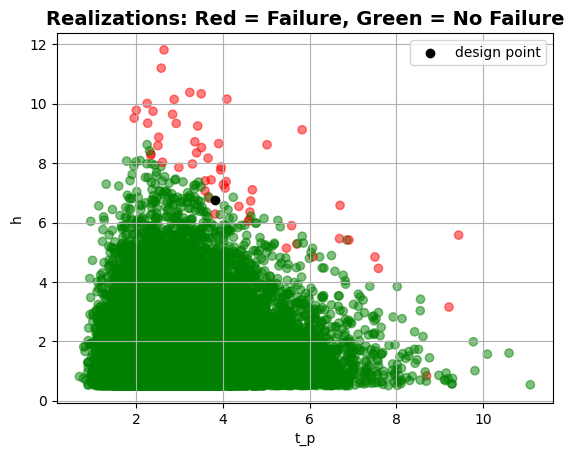
project.design_point.plot_realizations()
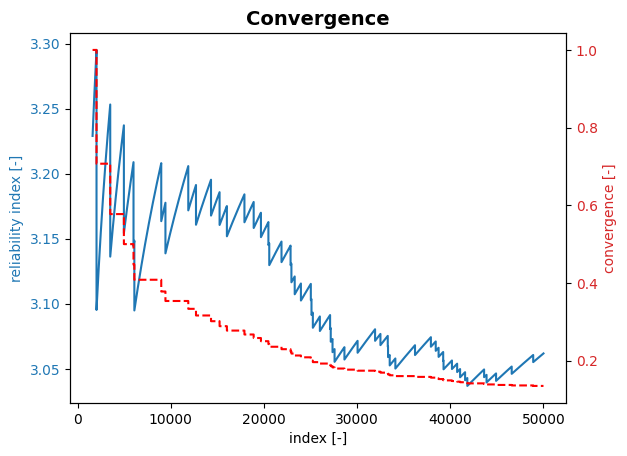
project.design_point.plot_convergence()
Reliability:
 Reliability index = 3.062
 Probability of failure = 0.0011
 Convergence = 0.1348 (not converged)
 Model runs = 50001
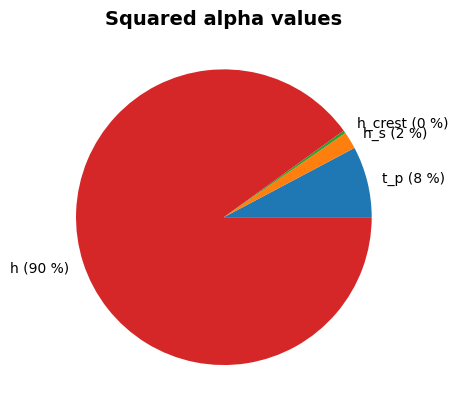
Alpha values:
 t_p: alpha = -0.299, x = 3.831
 tan_alpha: alpha = 0, x = 0.3333
 h_s: alpha = -0.1287, x = 3.234
 h_crest: alpha = -0.04707, x = 10.01
 h: alpha = -0.9444, x = 6.757
Perform reliability calculations with Directional Sampling#
We now conduct the reliability analysis using the directional_sampling method.
[32]:
project.settings.reliability_method = ReliabilityMethod.directional_sampling
project.settings.minimum_directions = 10000
project.settings.maximum_directions = 20000
project.settings.variation_coefficient = 0.02

project.run()

project.design_point.print()
project.design_point.plot_alphas()
Reliability (Directional Sampling)
 Reliability index = 3.068
 Probability of failure = 0.001078
 Convergence = 0.02748 (not converged)
 Model runs = 111509
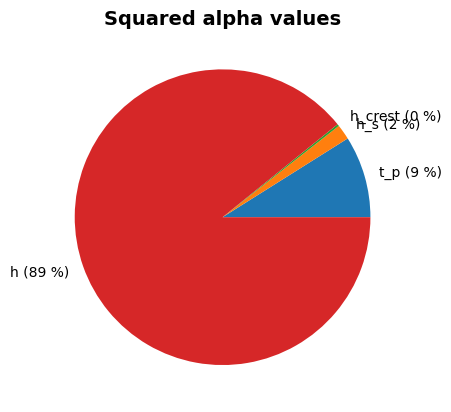
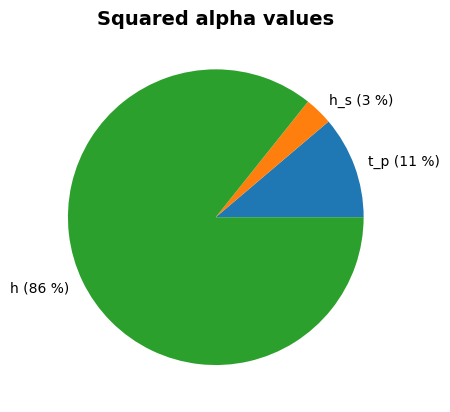
Alpha values:
 t_p: alpha = -0.3346, x = 3.972
 tan_alpha: alpha = 0, x = 0.3333
 h_s: alpha = -0.1756, x = 3.39
 h_crest: alpha = 0.006802, x = 9.999
 h: alpha = -0.9258, x = 6.595
Perform reliability calculations with Importance Sampling#
We now conduct the reliability analysis using the importance_sampling assuming the start value of \(u=1\) for the three random variables:
[33]:
project.settings.reliability_method = ReliabilityMethod.importance_sampling
project.settings.minimum_samples = 1000
project.settings.maximum_samples = 100000
project.settings.variation_coefficient = 0.02

project.settings.stochast_settings["t_p"].start_value = 1
project.settings.stochast_settings["h_s"].start_value = 1
project.settings.stochast_settings["h"].start_value = 1

project.run()

project.design_point.print()
project.design_point.plot_alphas()

#reset values
project.settings.stochast_settings["t_p"].start_value = 0
project.settings.stochast_settings["h_s"].start_value = 0
project.settings.stochast_settings["h"].start_value = 0
Reliability:
 Reliability index = 3.072
 Probability of failure = 0.001063
 Convergence = 0.02342 (not converged)
 Model runs = 100001
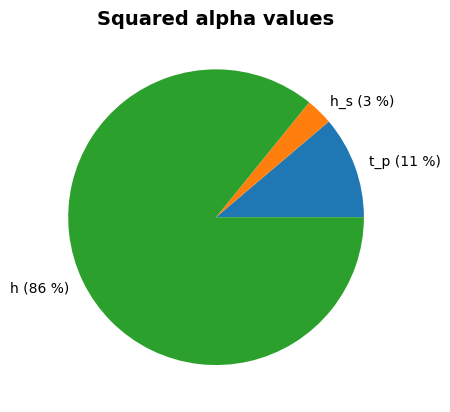
Alpha values:
 t_p: alpha = -0.3346, x = 3.973
 tan_alpha: alpha = 0, x = 0.3333
 h_s: alpha = -0.1721, x = 3.379
 h_crest: alpha = 0.009329, x = 9.998
 h: alpha = -0.9265, x = 6.613
Perform reliability calculations with Adaptive Importance Sampling#
We now conduct the reliability analysis using the adaptive_importance_sampling method.
[34]:
project.settings.reliability_method = ReliabilityMethod.adaptive_importance_sampling
project.settings.minimum_samples = 10000
project.settings.maximum_samples = 100000
project.settings.minimum_variance_loops = 5
project.settings.maximum_variance_loops = 10
project.settings.fraction_failed = 0.5
project.settings.variation_coefficient = 0.02

project.run()

project.design_point.print()
project.design_point.plot_alphas()
Reliability:
 Reliability index = 3.069
 Probability of failure = 0.001072
 Convergence = 0.02 (converged)
 Model runs = 50976
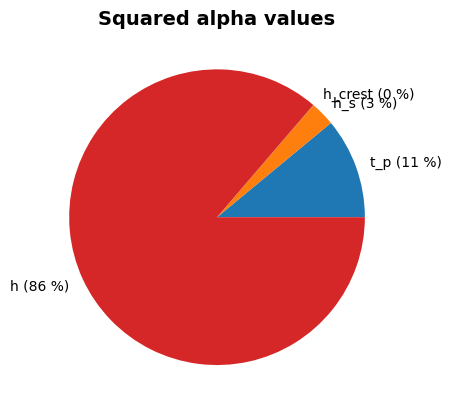
Alpha values:
 t_p: alpha = -0.3317, x = 3.961
 tan_alpha: alpha = 0, x = 0.3333
 h_s: alpha = -0.1642, x = 3.352
 h_crest: alpha = 0.01283, x = 9.998
 h: alpha = -0.9289, x = 6.63

Contributing design points:
  Reliability (Variance loop 1)
   Reliability index = 3.074
   Probability of failure = 0.001057
   Convergence = 0.1529 (not converged)
   Model runs = 10001
  Alpha values:
   t_p: alpha = -0.3606, x = 4.079
   tan_alpha: alpha = 0, x = 0.3333
   h_s: alpha = -0.2178, x = 3.537
   h_crest: alpha = -0.02189, x = 10
   h: alpha = -0.9066, x = 6.429

  Reliability (Variance loop 2)
   Reliability index = 3.07
   Probability of failure = 0.001069
   Convergence = 0.04657 (not converged)
   Model runs = 10001
  Alpha values:
   t_p: alpha = -0.3252, x = 3.935
   tan_alpha: alpha = 0, x = 0.3333
   h_s: alpha = -0.1697, x = 3.37
   h_crest: alpha = 0.01776, x = 9.997
   h: alpha = -0.9301, x = 6.644

  Reliability (Variance loop 3)
   Reliability index = 3.066
   Probability of failure = 0.001084
   Convergence = 0.04522 (not converged)
   Model runs = 10001
  Alpha values:
   t_p: alpha = -0.3276, x = 3.943
   tan_alpha: alpha = 0, x = 0.3333
   h_s: alpha = -0.1658, x = 3.357
   h_crest: alpha = 0.01809, x = 9.997
   h: alpha = -0.93, x = 6.63

  Reliability (Variance loop 4)
   Reliability index = 3.065
   Probability of failure = 0.001089
   Convergence = 0.04522 (not converged)
   Model runs = 10001
  Alpha values:
   t_p: alpha = -0.3279, x = 3.944
   tan_alpha: alpha = 0, x = 0.3333
   h_s: alpha = -0.1646, x = 3.352
   h_crest: alpha = 0.01749, x = 9.997
   h: alpha = -0.9301, x = 6.628

  Reliability (Variance loop 5)
   Reliability index = 3.065
   Probability of failure = 0.001087
   Convergence = 0.04526 (not converged)
   Model runs = 10001
  Alpha values:
   t_p: alpha = -0.3273, x = 3.942
   tan_alpha: alpha = 0, x = 0.3333
   h_s: alpha = -0.1649, x = 3.353
   h_crest: alpha = 0.0173, x = 9.997
   h: alpha = -0.9303, x = 6.631

  Reliability (Variance loop 6)
   Reliability index = 3.065
   Probability of failure = 0.001089
   Convergence = 0.04525 (not converged)
   Model runs = 10001
  Alpha values:
   t_p: alpha = -0.3276, x = 3.943
   tan_alpha: alpha = 0, x = 0.3333
   h_s: alpha = -0.1647, x = 3.353
   h_crest: alpha = 0.01697, x = 9.997
   h: alpha = -0.9302, x = 6.628

  Reliability (Variance loop 7)
   Reliability index = 3.065
   Probability of failure = 0.001088
   Convergence = 0.04527 (not converged)
   Model runs = 10001
  Alpha values:
   t_p: alpha = -0.3276, x = 3.943
   tan_alpha: alpha = 0, x = 0.3333
   h_s: alpha = -0.1649, x = 3.354
   h_crest: alpha = 0.01729, x = 9.997
   h: alpha = -0.9302, x = 6.629

  Reliability (Variance loop 8)
   Reliability index = 3.064
   Probability of failure = 0.00109
   Convergence = 0.04524 (not converged)
   Model runs = 10001
  Alpha values:
   t_p: alpha = -0.3274, x = 3.942
   tan_alpha: alpha = 0, x = 0.3333
   h_s: alpha = -0.1646, x = 3.352
   h_crest: alpha = 0.01697, x = 9.997
   h: alpha = -0.9303, x = 6.628

  Reliability (Variance loop 9)
   Reliability index = 3.065
   Probability of failure = 0.001087
   Convergence = 0.04529 (not converged)
   Model runs = 10001
  Alpha values:
   t_p: alpha = -0.3273, x = 3.942
   tan_alpha: alpha = 0, x = 0.3333
   h_s: alpha = -0.1654, x = 3.355
   h_crest: alpha = 0.01726, x = 9.997
   h: alpha = -0.9302, x = 6.629
Perform reliability calculations with Subset Simulation#
We now conduct the reliability analysis using the subset_simulation method.
[35]:
project.settings.reliability_method = ReliabilityMethod.subset_simulation
project.settings.minimum_samples = 1000
project.settings.maximum_samples = 50000
project.settings.variation_coefficient = 0.02
project.settings.sample_method = SampleMethod.adaptive_conditional

project.run()

project.design_point.print()
project.design_point.plot_alphas()
Reliability:
 Reliability index = 3.077
 Probability of failure = 0.001047
 Convergence = 0.01308 (not converged)
 Model runs = 45000
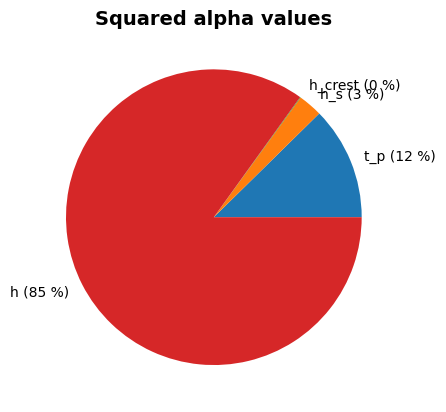
Alpha values:
 t_p: alpha = -0.3517, x = 4.044
 tan_alpha: alpha = 0, x = 0.3333
 h_s: alpha = -0.1625, x = 3.348
 h_crest: alpha = 0.02568, x = 9.996
 h: alpha = -0.9215, x = 6.579

Contributing design points:
  Reliability (Subset iteration 1)
   Reliability index = 3.062
   Probability of failure = 0.0011
   Convergence = 0.1348 (not converged)
   Model runs = 50001
  Alpha values:
   t_p: alpha = -0.299, x = 3.831
   tan_alpha: alpha = 0, x = 0.3333
   h_s: alpha = -0.1287, x = 3.234
   h_crest: alpha = -0.04707, x = 10.01
   h: alpha = -0.9444, x = 6.757

  Reliability (Subset iteration 2)
   Reliability index = 3.075
   Probability of failure = 0.001054
   Convergence = 0.04333 (not converged)
   Model runs = 45000
  Alpha values:
   t_p: alpha = -0.3562, x = 4.061
   tan_alpha: alpha = 0, x = 0.3333
   h_s: alpha = -0.1712, x = 3.376
   h_crest: alpha = 0.01876, x = 9.997
   h: alpha = -0.9184, x = 6.543
Perform reliability calculations with Latin hypercube#
We now conduct the reliability analysis using the latin_hypercube.
[36]:
project.settings.reliability_method = ReliabilityMethod.latin_hypercube
project.settings.minimum_samples = 100000

project.run()

project.design_point.print()
project.design_point.plot_alphas()
Reliability:
 Reliability index = 3.076
 Probability of failure = 0.00105
 Convergence = 0.09754 (not converged)
 Model runs = 100001
Alpha values:
 t_p: alpha = -0.2787, x = 3.759
 tan_alpha: alpha = 0, x = 0.3333
 h_s: alpha = -0.1373, x = 3.264
 h_crest: alpha = 0.05574, x = 9.991
 h: alpha = -0.9489, x = 6.843