
Notebook
Run it live:

Download this notebook: 00_introduction.ipynb
00 - Introduction#
Assumptions#
We assume you are already familiar with Delft-FEWS. If not, feel free to take a look at our website.
Learning goals of this module#
Understand the overall goal of this tutorial
Understand what OpenFEWS is
Understand what hindcasts are available in OpenFEWS
Understand how veriflow was designed to smoothly integrate with Delft-FEWS, through the Delft-FEWS PI Webservice
Setting the Scene#
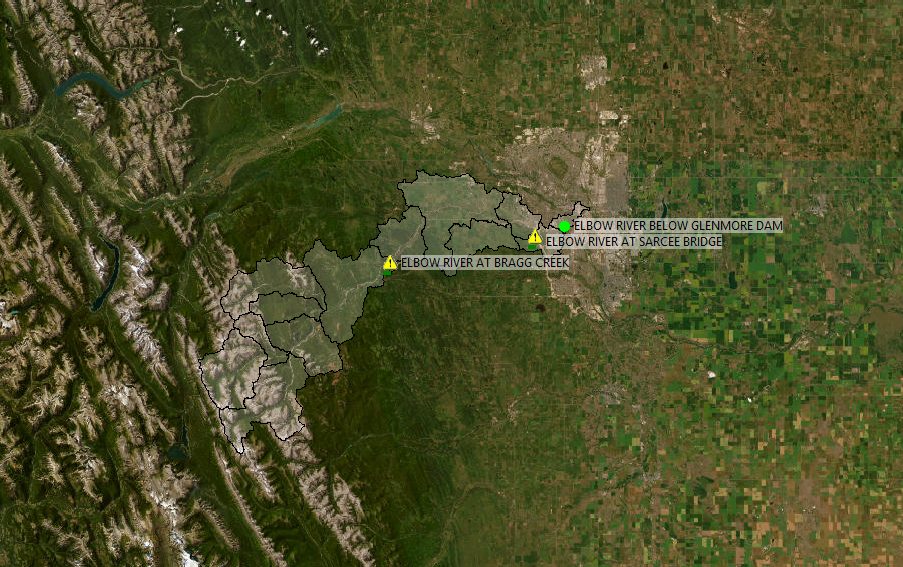
This tutorial focuses on a specific and recent event in the Elbow Watershed in Alberta, Canada. Previous floods in this catchment had caused catastrophic damage to the City of Calgary in 2013.
In this recent June, 2026 event, high flows were caused by the combination of snowmelt and rainfall. This caused high river advisories in many areas of the Bow Catchment, but fortunately minimal flooding and damage.
Rainfall as a driving and uncertain force#
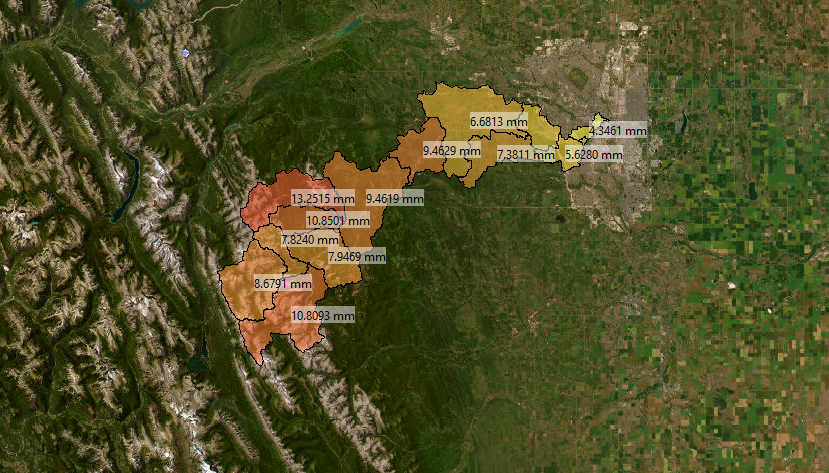
The rainfall over the Elbow was forecasted differently by a variety of Numerical Weather Prediction (NWP) models. In this case study, we look at the predictions of a deterministic (GDPS) and ensemble (GEPS, GEFS, IFS) NWP models. We can compare these NWP models to station observations and reanalysis (RDPA, HRDPA) products.
We want to see which models predicted the rainfall well, and what the skill is over (lead-) time.
Hydrological Forecasting#
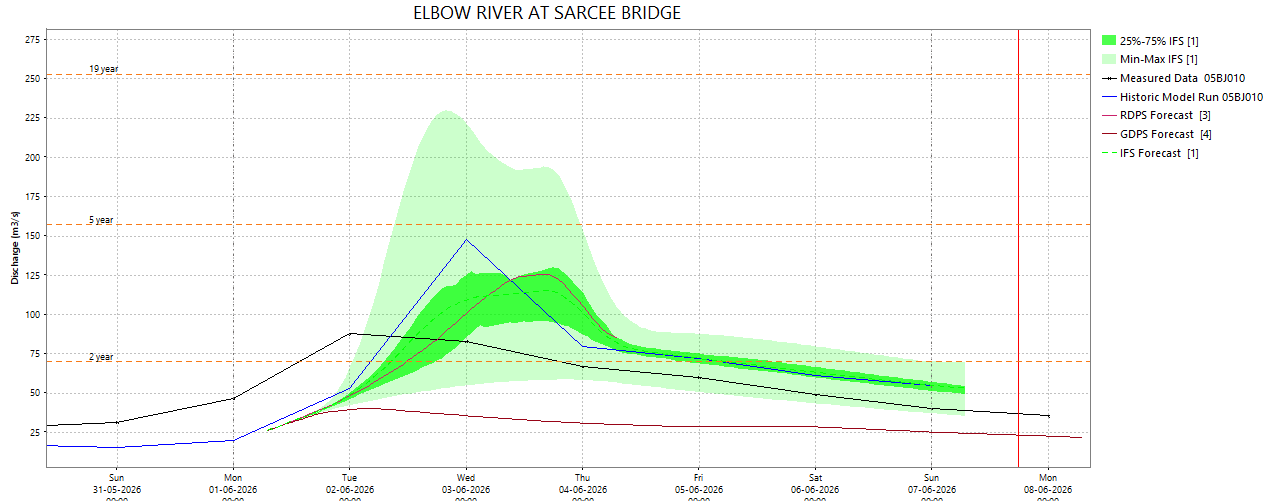
We also predict the hydrological response in the catchment using a hydrological model (Raven). The model simulation using observed data was pretty accurate! But we want to see how well it was forecasted!
In the simple image below, we can see that two days before the event, the RDPS forecast predicted the magnitude well, while the GDPS forecast missed it completely. We’ll try to verify the forecasts to figure out why!
Verification with veriflow#
We use veriflow to do the analysis. Because veriflow has native integration with Delft-FEWS, we can easily access the data in OpenFEWS, that is available in the system. In this tutorial, we expose the data in this study using the Delft-FEWS PI Webservice on a public URL. Because the service is running on the web, you can run this tutorial from anywhere as long as the URL is working.
Resources:#
veriflow GitHub page: Deltares/veriflow
veriflow Documentation page: https://deltares.github.io/veriflow/
OpenFEWS Github page: CH-Earth/OpenFEWS
Delft-FEWS website: https://oss.deltares.nl/web/delft-fews